
9 types of intelligences
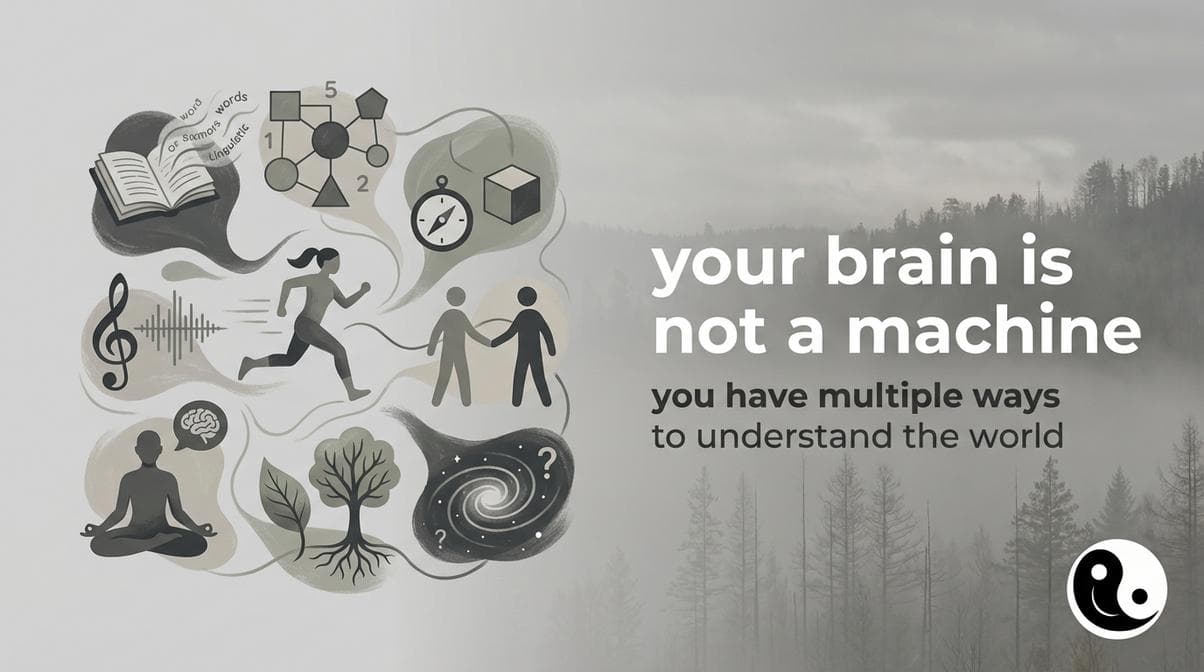
you spent your entire childhood being graded on a narrow slice of what intelligence actually is. if you were good at math and reading, you were "smart." if you weren't, you internalized a lie about yourself that might still be running the show.
the full picture
howard gardner identified nine distinct types of intelligence:
- naturalist -- understanding living things and the natural world
- musical -- sensitivity to rhythm, pitch, tone, and composition
- logical-mathematical -- reasoning, problem-solving, and abstract thinking
- existential -- tackling deep questions about human existence and meaning
- interpersonal -- understanding and relating to other people
- kinesthetic -- body awareness, coordination, and physical skill
- linguistic -- facility with words, language, and expression
- intrapersonal -- deep self-knowledge and emotional awareness
- spatial -- thinking in three dimensions, visualization, and mental imagery
you're strong in some of these and weak in others. most people have never mapped it out.
why this ranking matters
when you know your intelligence profile, you stop trying to succeed using someone else's strengths. the person with massive interpersonal intelligence who keeps trying to be a solo coder is fighting against their own wiring. the kinesthetic genius stuck in a desk job is slowly dying inside.
your strongest intelligences point toward the work and activities where you'll naturally excel. your weakest ones show you where you need to either improve or delegate.
rank yourself
grab a piece of paper. list all nine. rank them from strongest to weakest based on honest self-assessment, not what you wish were true. then ask: does my current life align with my top three? if not, something needs to change.
this isn't about excuses. it's about strategy. play to your strengths, shore up your weaknesses where it matters, and stop measuring yourself against a one-dimensional definition of smart.
if this resonated, share it with someone who needs to hear it.