
failure is a story you tell yourself
here's what actually happens when you "fail": an event occurs that doesn't match your expectation. that's it. everything after that — the shame, the identity crisis, the "i'm not good enough" spiral — is narration. it's a story you're telling about a neutral event.
you applied for a job and didn't get it. that's a fact. "i'm not qualified enough" is a story. "the market is too competitive for someone like me" is a story. "i'll never get where i want to go" is a story.
the event doesn't change. but the story you wrap around it determines whether it destroys you or teaches you. and you get to choose the story.
this isn't naive optimism. the stoic philosopher marcus aurelius wrote: "the impediment to action advances action. what stands in the way becomes the way." he wasn't saying obstacles are fun. he was saying they contain information you can use — if you stop drowning in the narrative long enough to look for it.
the first step in embracing failure is recognizing that failure as you understand it — as a verdict on your worth — doesn't exist. what exists is outcomes, and outcomes are data.
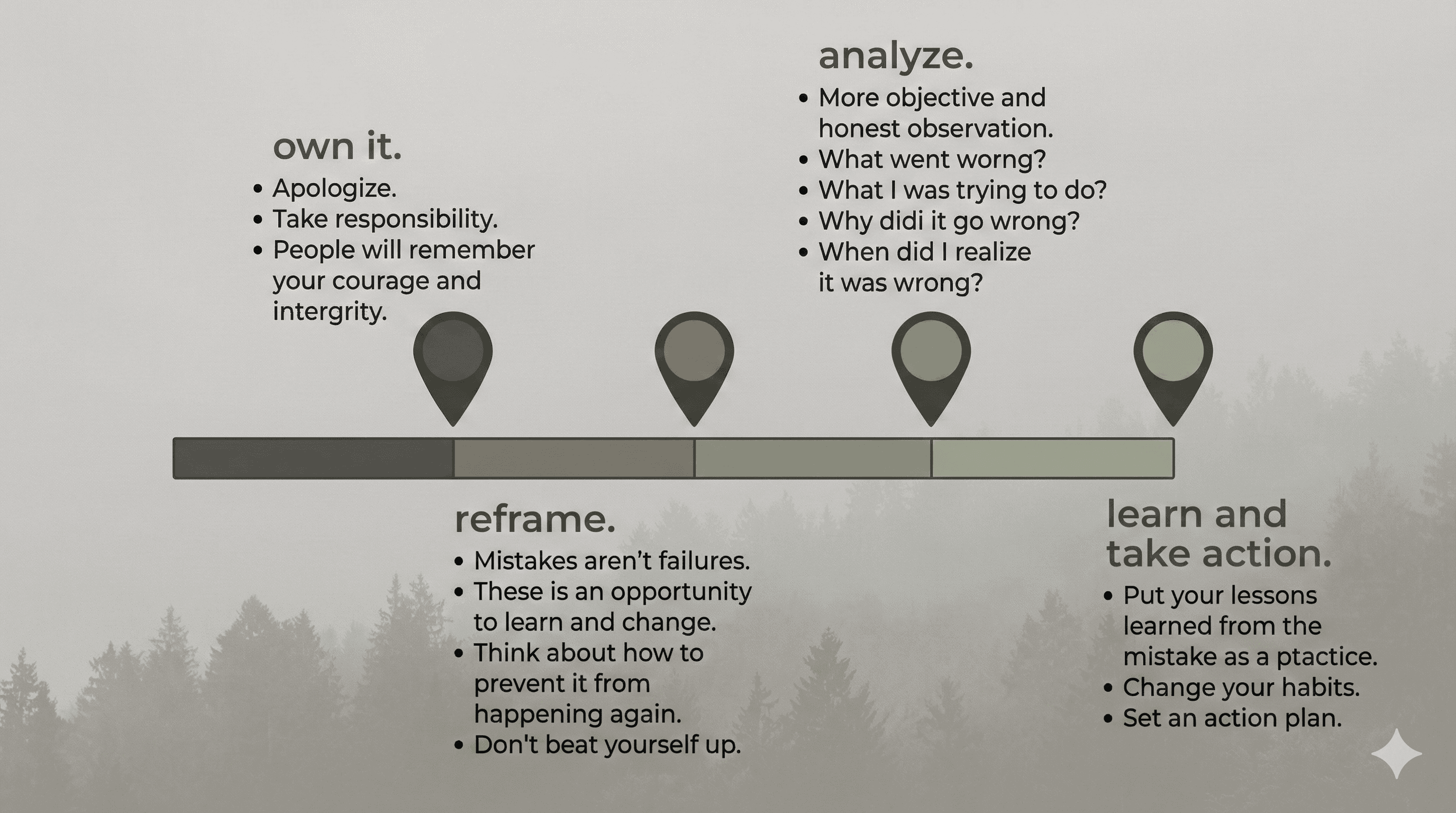
own it, reframe it, analyze it, act on it
this is the framework. four steps, in order. skip one and the whole thing collapses.
own it. take responsibility for your part. not self-flagellation — that's just ego wearing a hair shirt. honest ownership. "i underprepared for that interview." "i didn't communicate clearly enough." "i took a risk that didn't pay off." ownership is power. blame is surrender.
reframe it. shift from "this happened to me" to "this happened and here's what it contains." a failed business isn't a catastrophe — it's an expensive education. a rejected manuscript isn't proof you can't write — it's information about what one editor wanted at one moment in time. the reframe doesn't erase the pain. it redirects it.
analyze it. get clinical. what specifically went wrong? what was in your control and what wasn't? what assumptions did you make that turned out to be false? what would you do differently with the information you have now?
this step requires honesty without brutality. you're conducting a post-mortem, not a prosecution.
act on it. change something. adjust the strategy. acquire a missing skill. try a different approach. if your analysis doesn't lead to action, it's just intellectualized self-pity. the point of understanding what went wrong is to do something about it.
own. reframe. analyze. act. run this loop enough times and failure stops being an ending. it becomes a turn in the road.
building a failure resume
most people curate a highlight reel of their successes. try the opposite: build a failure resume.
list your rejections, your bad decisions, your projects that went nowhere, your relationships that ended, your ideas that flopped. be specific. include what you learned from each one.
this isn't masochism. it's calibration. when you see all your failures in one place, two things happen.
first, you realize how many there are — and that you survived all of them. your track record of getting through hard things is actually perfect. you're still here.
second, you start to see patterns. maybe you rush into things without enough preparation. maybe you avoid asking for help. maybe you quit at the first sign of resistance. patterns are gold. patterns are what you can actually change.
tina seelig, a stanford professor, has her students create failure resumes as a formal exercise. the students who do it consistently report that it reduces their fear of failure. it's hard to be terrified of something you've catalogued and survived dozens of times.
some of the most successful people in history were prolific failures first. the specific examples don't matter — you've heard them all. what matters is the principle: the people who succeed most are the people who fail most, because they try more.
failure as timeline, not destination
the most destructive belief about failure is that it's permanent. "i failed" becomes "i am a failure" — the event becomes an identity.
but failure is a moment in time, not a place you live. you failed at that thing, on that day, with the information and skills you had then. tomorrow you'll have more information and better skills. next year, even more.
the buddhist concept of impermanence applies here: nothing is fixed. not your circumstances, not your abilities, not your identity. the person who failed last year doesn't have to be the person who fails next year. but they will be, if they decide that failure is who they are rather than something that happened to them.
think of failure as a timeline — a sequence of events you move through, not a room you're locked in. every failure has a "before" and an "after." the "before" is the attempt. the "after" is the choice: do you stay down, or do you get up with better information?
the japanese art of kintsugi repairs broken pottery with gold, making the breaks visible rather than hiding them. the piece doesn't pretend it was never broken. it integrates the break into something more interesting than the original.
your failures are the gold lines in your story. not something to hide or be ashamed of, but something that makes you more complex, more resilient, and more real than someone who never broke at all.
the real risk
people think the risk is in trying and failing. it's not. the risk is in never trying and spending the rest of your life wondering.
regret research consistently shows that people regret inaction more than action. at the end of life, "i wish i had tried" outweighs "i wish i hadn't failed" by a massive margin.
so fail. fail often. fail publicly if you're brave enough. fail privately if you're not there yet. but fail forward — with the own-reframe-analyze-act framework in hand, turning every stumble into a step.
the goal was never to avoid failure. the goal is to build such a strong relationship with failure that it stops being something you fear and starts being something you use.
that's what it means to embrace it. not to love it. not to seek it out for its own sake. but to stop running from it, look it in the eye, and say: "i see you. now what are you going to teach me?"